%20{%20.logo-h%20{%20fill:%20transparent;%20/*%20No%20fill,%20just%20the%20outline%20*/%20stroke:%20%23222222;%20/*%20Dark%20stroke%20for%20visibility%20*/%20stroke-width:%2010px;%20/*%20Slightly%20thicker%20stroke%20for%20better%20visibility%20*/%20}%20}%20/*%20For%20dark%20mode%20only%20*/%20@media%20(prefers-color-scheme:%20dark)%20{%20.logo-h%20{%20fill:%20%23ffffff;%20stroke:%20rgba(255,%20255,%20255,%200);%20/*%20Transparent%20stroke%20for%20dark%20mode%20*/%20}%20}%20%3c/style%3e%3cpath%20class='logo-h'%20d='M128,96%20v320%20h64%20v-128%20h128%20v128%20h64%20v-320%20h-64%20v128%20h-128%20v-128%20z'/%3e%3c!--%20Red%20to%20cyan%20gradient%20line%20with%20upward%20Texas%20Longhorn-style%20curve%20--%3e%3clinearGradient%20id='gradient'%20x1='0%25'%20y1='0%25'%20x2='100%25'%20y2='0%25'%3e%3cstop%20offset='0%25'%20style='stop-color:%23ef4444;stop-opacity:1'%20/%3e%3cstop%20offset='100%25'%20style='stop-color:%2306b6d4;stop-opacity:1'%20/%3e%3c/linearGradient%3e%3c!--%20Texas%20Longhorn%20style%20curved%20path%20pointing%20upward%20--%3e%3cpath%20d='M96,448%20C120,470%20170,455%20256,440%20C342,455%20392,470%20416,448%20L416,432%20C392,450%20342,435%20256,420%20C170,435%20120,450%2096,432%20Z'%20fill='url(%23gradient)'/%3e%3c/svg%3e)
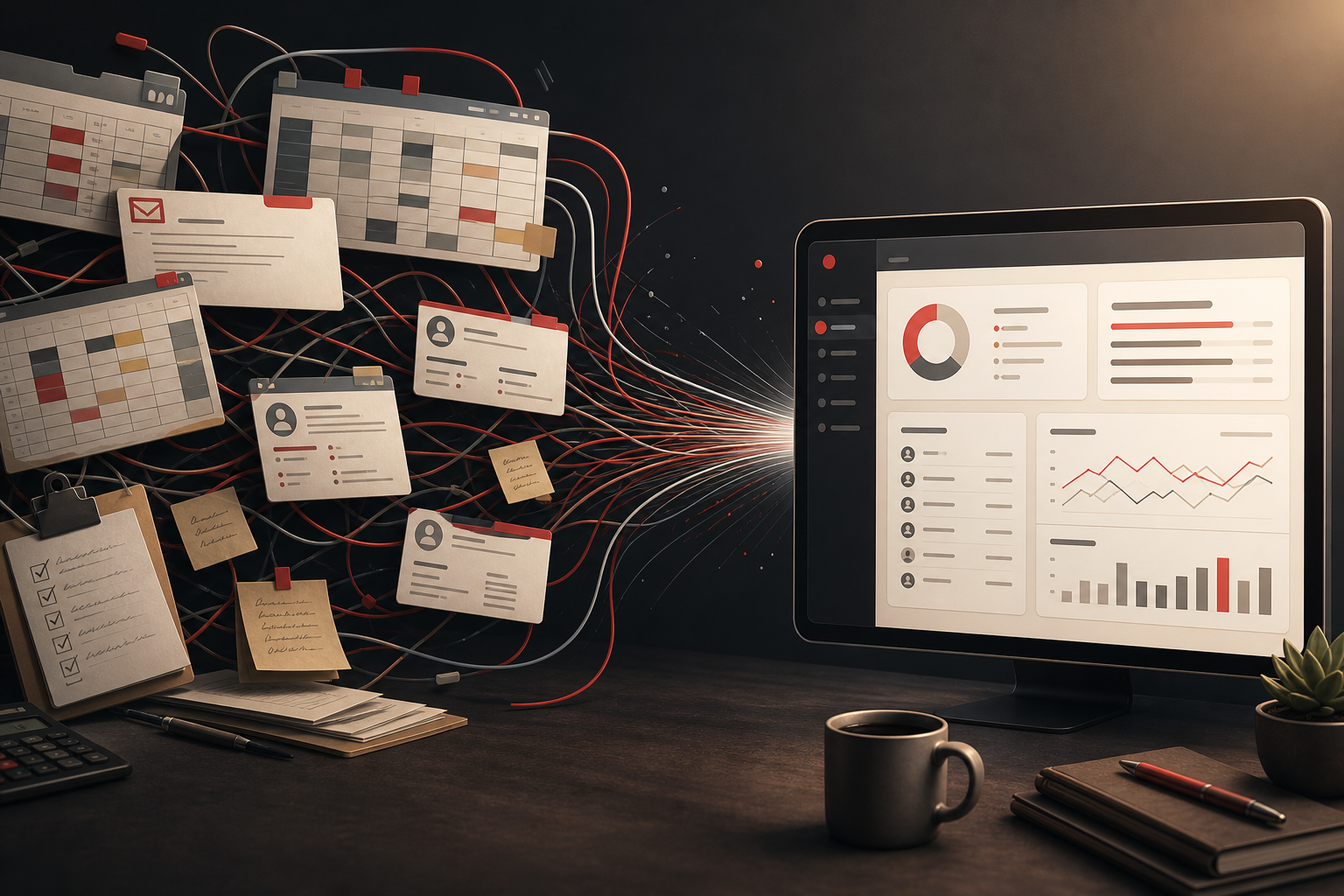
Most growing businesses do not wake up one morning and decide they need custom software. They accumulate workarounds—a critical Google Sheet, a Zap that breaks monthly, a senior employee who is the only person who knows how billing really works. Custom software becomes the answer when those workarounds start costing real money and real time.
Sign 1: Your spreadsheet is the system of record
If customer data, inventory levels, or project status live primarily in a spreadsheet—not in software designed for concurrent users and permissions—you are carrying operational risk. We see teams where one accidental sort deletes a week of work, or where two people edit the same row and nobody notices until a client calls.
Spreadsheets are excellent for thinking and prototyping. They are poor at being the backbone of fulfillment, billing, or compliance. When leadership asks “what is our status on X?” and someone opens a tab—not a dashboard—you have crossed a line.
Sign 2: You are paying for five tools to do one job
A common pattern: CRM for contacts, a form builder for intake, a project tool for tasks, Zapier for glue, and a spreadsheet for the report nobody trusts. Fifteen seats across those tools can run $2,500–$5,000 per month—and your team still copies data by hand.
- Duplicate entry—the same customer name typed into three systems weekly
- Subscription creep—each department bought a tool that overlaps with another
- Export rituals—Monday morning means five CSV downloads and one fragile pivot table
- No single answer—CRM and ops disagree on revenue or backlog numbers
Sign 3: One person is the human API
When a single employee receives forwarded emails, updates a sheet, pings Slack, and triggers billing manually, that person is your integration layer. It works until they are sick, on vacation, or burned out. Businesses that depend on a human router for core workflows are fragile—and that fragility shows up in delayed invoices, missed follow-ups, and hiring bottlenecks because “only Sarah knows how we do it.”
What replacing the human API looks like
Custom software does not eliminate judgment—it routes work so judgment happens in a queue with context, not in an inbox thread. A fulfillment lead might still approve exceptions, but they approve them in an app with history, not by replying “ok” to an email nobody can find later.
Sign 4: Your process has rules software should enforce
If your ops handbook says “never ship without signed approval” but the sheet has no way to enforce that, you are relying on memory. Rules that matter for revenue, safety, or contracts should live in software: required fields, approval chains, blocked states, audit logs.
- Role-based permissions—billing sees dollars; ops sees SKUs; clients see only their orders
- Approval workflows—discounts, scope changes, or refunds need a named approver
- Validation—dates, quantities, and IDs checked before anything downstream runs
- Audit trail—who changed what, when, for disputes and internal reviews
Sign 5: Generic SaaS forces you to change how you work
Off-the-shelf products optimize for the average customer. If you constantly bend your process to fit the tool—extra custom fields, workarounds in notes, “we use the project tool as a CRM”—you are paying for flexibility you are not getting. Custom software fits your workflow; you do not retrain twenty people to match a vendor’s roadmap.
That is especially true in niche industries: specialty manufacturing, regulated services, multi-location franchises, and businesses with customer-specific pricing. The $50/month app was never designed for your edge cases—and your edge cases are where margin lives or dies.
Sign 6: Errors are expensive and recurring
A wrong shipment costs $200 in freight and a relationship. A duplicate invoice creates accounting cleanup. A missed renewal loses $10,000 in annual revenue. When the same class of mistake happens more than twice a quarter because data was wrong, stale, or entered twice, manual process is no longer cheaper than software.
Rough math most owners skip
If manual errors and rework cost you $2,000 per month in labor and refunds, a $15,000 custom milestone that cuts that by 70% pays back in about eleven months—before you count faster fulfillment or happier customers. Spreadsheet errors are not free; they are just invisible on a P&L until someone adds them up.
Sign 7: Growth is blocked by systems, not demand
You have leads you cannot onboard fast enough. You hesitate to hire because training takes six weeks of shadowing the spreadsheet wizard. You turn down work because tracking it in current tools would break. When systems cap revenue instead of supporting it, custom software is a growth investment—not a luxury IT project.
Signs you might not need custom software yet
Honesty matters. If the pain is only notifications and syncs—and your sheet is still the right interface—start with automation, not a full build. If only one person uses the data and volume is low, a better template might suffice. If requirements change every week, you need discovery and a narrow milestone before a big commit.
- Stable data model—columns and statuses are not reinvented monthly
- Clear owner—someone internal will maintain the tool after launch
- One workflow first—not “replace everything we use” in phase one
- Measurable pain—hours lost, error rate, or revenue delayed—you can name a number
What to do when you recognize three or more signs
Pick the workflow where failure hurts most: billing, onboarding, inventory exceptions, or customer status. Document it in plain language—who does what, which tools are touched, what breaks today. That becomes milestone one scope, not a year-long requirements doc.
Our custom software for small business engagements start there: one team, one workflow, shippable in weeks. You do not need to know React or APIs—you need to know where your business bleeds time.
If spreadsheets are part of the problem but not the only problem, read how custom business software differs from bolting more zaps onto tools you already resent. The goal is fewer places where truth lives, not another login.
How custom software shows up in day-to-day work
Good internal software feels boring on a good day. Orders move without a status meeting. Exceptions land in a queue with context—not as a forwarded email with “see below.” New hires learn one tool instead of a folklore tour of tabs. That boredom is what you are buying: fewer heroics, more predictable output.
Bad internal software copies the spreadsheet into a web form without fixing permissions or rules—then adds login fatigue. The fix is not more features; it is fewer steps between “I know what to do” and “it is done,” with guardrails where mistakes used to happen.
The bottom line
Custom software is not for businesses that love tinkering with tech. It is for businesses that have outgrown workarounds and need reliable workflows, clear permissions, and integrations that do not fail silently. If your ops story sounds like “we have a sheet, a zap, and a person who fixes it”—you are not early; you are overdue for a deliberate fix.
Start with a 30-minute audit
Walk one order, one client, or one hire from first touch to done. Count tools, exports, and “ask Sarah” moments. If you hit more than six handoffs, you have evidence—not gut feel—that systems are shaping outcomes. That map becomes the agenda for a serious build conversation instead of a generic demo.